

PPI Inflation Undershoots as Equities Grind Higher Into Records
Introduction
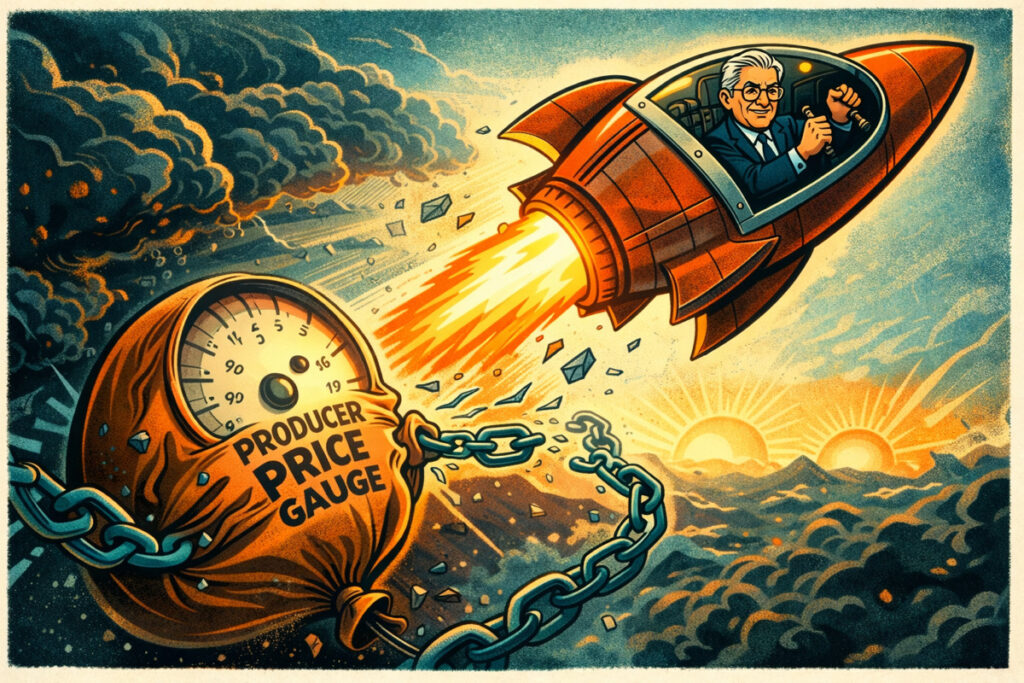
U.S. producer price index for December surprised to the downside with a 1.0% annual increase on January 14, 2025, below the forecasted 1.3%, signaling continued disinflationary pressures at wholesale levels. The Labor Department released the data, influencing Fed watchers and investors across Wall Street and global bourses. This outcome matters today by bolstering prospects for Federal Reserve rate cuts, supporting elevated equity valuations in a high-rate environment. Markets responded with measured gains: the Dow Jones Industrial Average rose 0.52% to 42,518, the S&P 500 notched a new record close up 0.11%, while the Nasdaq Composite slipped marginally amid tech sector rotation.
Body
Equities in the United States displayed resilience despite intraday volatility, grinding toward fresh milestones as the PPI miss alleviated immediate inflation fears. The Dow Jones Industrial Average advanced 221 points, or 0.52%, to close at 42,518, rebounding from a midday dip triggered by sticky core services components within the report. The S&P 500 eked out a 0.11% gain to 5,843, marking its ninth record high in ten sessions, driven by broad participation beyond the usual suspects. Sector leadership shifted toward defensive and cyclical names: energy surged 2.5% on oil stabilization, healthcare climbed 1.2% led by UnitedHealth and Johnson & Johnson, while consumer staples added 0.8%. Financials held steady despite regional bank pressures, with JPMorgan up modestly on trading revenue beats. Technology lagged, down 0.3%, as Nvidia and Apple faced profit-taking after recent AI-driven rallies, highlighting the ongoing rotation from mega-caps to value plays. The Nasdaq Composite fell 0.2% to around 18,400, extending its fifth consecutive decline, but market breadth remained healthy with advancing issues outnumbering decliners by 1.8 to 1 on the NYSE. The CBOE Volatility Index, or VIX, hovered in the low teens at 13.2, reflecting subdued fear levels despite elevated valuations, with the S&P 500’s forward P/E at 21.5 times earnings.
In Europe, bourses mirrored the cautious optimism, with the Stoxx Europe 600 index edging up 0.2% as PPI data supported ECB hold expectations. Basic materials gained 1.1% on commodity tailwinds, while banks like BBVA rallied 3% on strong Iberian lending. The FTSE 100 in London rose 0.4%, buoyed by energy giants Shell and BP amid stable Brent prices. Germany’s DAX advanced 0.3%, export-heavy autos like Volkswagen benefiting from weaker euro forecasts. French CAC 40 lagged slightly on luxury goods weakness, LVMH down 1% on China demand concerns.
Asian markets rebounded overnight, with Hong Kong’s Hang Seng soaring 1.92% fueled by a chip stock rally despite U.S. export restrictions, Tencent and Alibaba up over 2%. Japan’s Nikkei 225 added 0.8% as yen weakened to 156 per dollar, exporters like Toyota gaining. China’s Shanghai Composite steadied after recent stimulus announcements, though mainland PMIs disappointed at 49.3, signaling contraction. Overall, equities reflected a global grind higher, with U.S. PPI undershoot reinforcing disinflation themes and rotation dynamics.
Bond markets exhibited a bifurcated response, with Treasuries initially rallying on the headline miss but paring gains as core PPI details revealed persistent services inflation. The benchmark 10-year U.S. Treasury yield closed at 4.56%, up 2 basis points intraday after touching 4.52%, while the 2-year note yield rose to 4.32%, flattening the curve slightly to -24 basis points 2s10s. Market-implied probabilities shifted modestly, with Fed funds futures pricing a 75% chance of a March 25 basis point cut from the current 4.25-4.50% range, down from 82% pre-PPI. December’s core PPI ex-food and energy climbed 2.9% annually, hotter than the 2.7% forecast, driven by airfares and hospital services, tempering aggressive easing bets. Eurozone Bund yields edged lower to 2.15% for the 10-year, aligning with ECB’s data-dependent stance post-Lagarde’s comments on wage moderation. UK Gilts saw 10-year yields at 4.02%, stable amid BoE minutes signaling patience. Japanese Government Bonds remained anchored near zero, with BoJ Governor Ueda reiterating gradual normalization.
Currencies traded in narrow ranges, with the U.S. dollar index slipping 0.1% to 102.8 as PPI relief weighed on hawkish positioning. EUR/USD recovered to 1.0215 after dipping below 1.02, supported by eurozone PMI resilience. GBP/USD stabilized near 1.215 amid sterling’s commodity sensitivity, while USD/JPY climbed to 156.80, prompting Tokyo intervention warnings as exporters cheered. Emerging market currencies shone: the Brazilian real strengthened 0.5% on commodity flows, South African rand hit 18.85 per dollar forecast lows. Offshore Chinese yuan firmed slightly on PBOC liquidity injections, underscoring EM outperformance versus G10 amid U.S. data digestion.
Commodities mostly held ground, with energy leading gains amid geopolitical premiums. WTI crude oil peaked intraday at $78 before settling down 1% to $76.50 per barrel, pressured by ample U.S. supply despite Middle East tensions. Brent mirrored at $80.20. Precious metals retreated: spot gold fell 0.83% to $2,668 per ounce from recent highs, silver down 2.56% to $31.10 as dollar rebound capped haven appeal. Industrial metals were mixed; copper steadied at $4.25 per pound on Chinese demand hopes post-PMI, aluminum up 0.5%. Agricultural futures eased, soybeans down 1% on South American harvest prospects. The complex underscored cyclical stabilization, with PPI pass-through risks muted by goods disinflation.
Cryptocurrencies extended rallies pre-data release, with Bitcoin blasting past $95,000 for the first time since December peaks, up 3% intraday on institutional ETF inflows topping $2 billion weekly. Ethereum surged 7% to $3,300, altcoin season hints emerging as SOL and LINK gained 10-12%. Total crypto market cap crossed $3.2 trillion, DeFi TVL at records, reflecting decorrelation from traditional assets amid rate cut optimism. BTC dominance slipped to 52%, signaling broad participation.
Integrating macro developments, the PPI undershoot versus expectations (headline 1.0% vs 1.3%, core services sticky at 3.9%) reinforced the Fed’s soft landing trajectory, with prior nonfarm payrolls adding 256,000 jobs and unemployment steady at 4.1%. Central bank communications remained vigilant: ECB’s Kazaks warned of no complacency amid U.S. political attacks on Fed independence, BoJ delayed hikes amid yen weakness. Fiscal policy loomed with Trump’s inauguration pledges for tax cuts and tariffs, potentially reigniting inflation. Geopolitical tensions in Red Sea supported oil but did not dominate. Market psychology stayed constructive, risk sentiment buoyed by breadth—S&P up issues 320 vs down 180—though high valuations cap upside. Cross-asset ties coherent: milder PPI lifted equities modestly, firmed yields on core details, softened dollar aiding EM/commodities, crypto decoupled upward.
European PMIs for January flashed early at 47.7 composite, contraction persisting but services steady. China’s December retail sales beat at 3.7%, industrial output 6.8%, balancing property woes. Policy outlooks diverged: Fed March cut favored 75%, ECB June hold, BoJ watchful. Outcomes beat expectations on wholesale disinflation, tempering services heat, fostering grind higher in risk assets without euphoria.
Conclusion
Key signals confirm disinflation progress amid resilient growth. Forward scenarios include accelerated Fed easing if CPI follows suit, or pause if services inflation persists. Investor risks encompass fiscal stimulus overheating, tech bubble burst, geopolitical oil shocks; open questions on election policy execution and global PMI trough timing.
